

Slocum Glider
Product descripton: Slocum Glider by Teledyne Marine
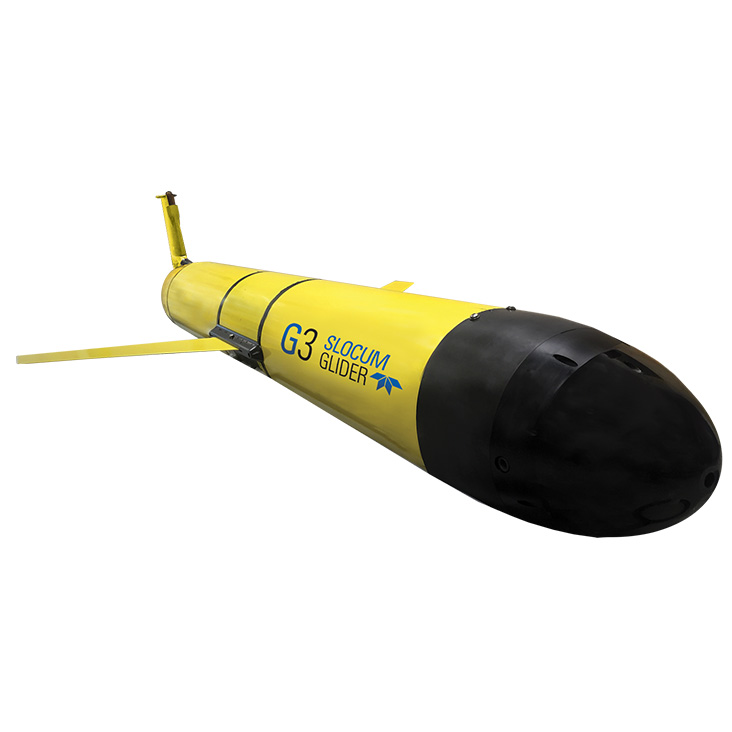
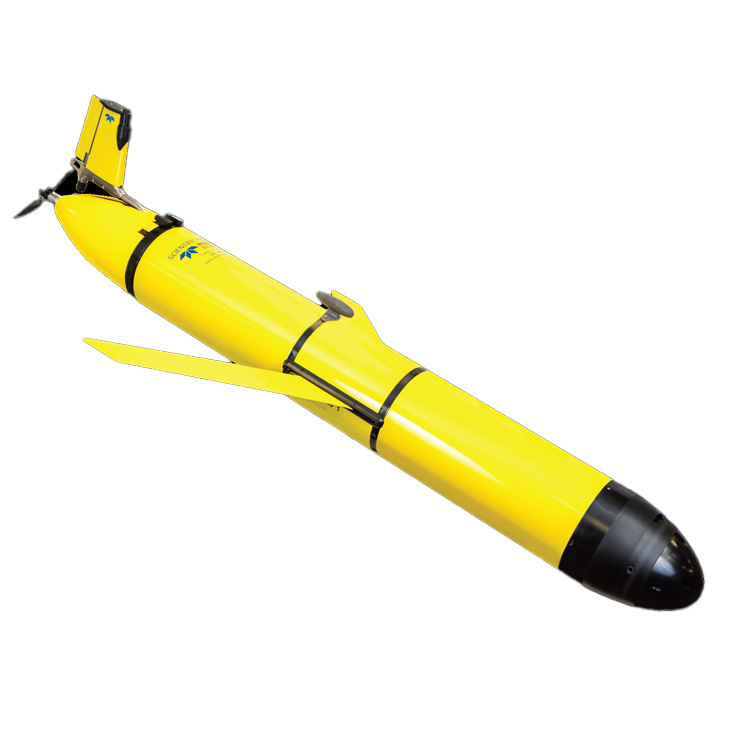
The Teledyne Webb Research Slocum Glider is a pioneering autonomous underwater vehicle (UUV) designed for long-range, long-duration ocean observation and scientific, commercial, and defense applications. As the foundation of modern ocean glider technology, the Slocum Glider provides a highly flexible sensor platform capable of carrying one of the widest selections of payloads available among glider AUV systems.
Powered by an energy-efficient buoyancy propulsion system, the Slocum Glider enables persistent water-column monitoring with minimal operational requirements. The platform can be deployed and recovered from vessels of various sizes and remotely controlled worldwide through web-based piloting tools, allowing operators to manage individual vehicles or entire fleets with reduced personnel and infrastructure needs.
The modular design of the Slocum Glider allows rapid sensor reconfiguration to support changing mission requirements. With a dry modular center payload bay, additional wet sensor bays, and compatibility with more than 40 sensors and mission options, the system can be adapted for diverse oceanographic, environmental, military, and commercial applications.
Key Applications
- Oceanographic research and environmental monitoring
- Defense and maritime security missions
- Long-duration water-column observation
- Climate and ecosystem studies
- Coastal and offshore monitoring
- Autonomous distributed sensing networks
- Scientific and commercial ocean surveys
Technical specifications
| Parameter | Specification |
|---|---|
| Deployment | Versatile deployment with 1–2 people; LARS options available |
| Power Options | Alkaline (A) / Rechargeable Lithium (Li) / Lithium Primary (L) |
| Range | 350–1,200 km / 700–3,000 km / 3,000–13,000 km (depending on power source) |
| Deployment Duration | 15–50 days / 1–4 months / 4–18 months (depending on power source) |
| Operating Depth Options | 4–150 m or 40–1,000 m (configuration dependent) |
| Navigation Systems | GPS, pressure sensor, altimeter, dead reckoning |
| Communication Systems | RF modem, Iridium (RUDICS), ARGOS, acoustic modem |
| Horizontal Speed | Buoyancy engine: 0.35 m/s (0.68 knots) average; up to 0.5 m/s (1 knot) with full drive |
| Thruster Speed | Up to 1 m/s (2 knots) |
| Mass | 55–70 kg (depending on configuration) |
| Vehicle Length | 1.5 m |
| Hull Diameter | 22 cm |
| Note | Endurance and range depend on sensor configuration, sampling frequency, energy source, and communication requirements |